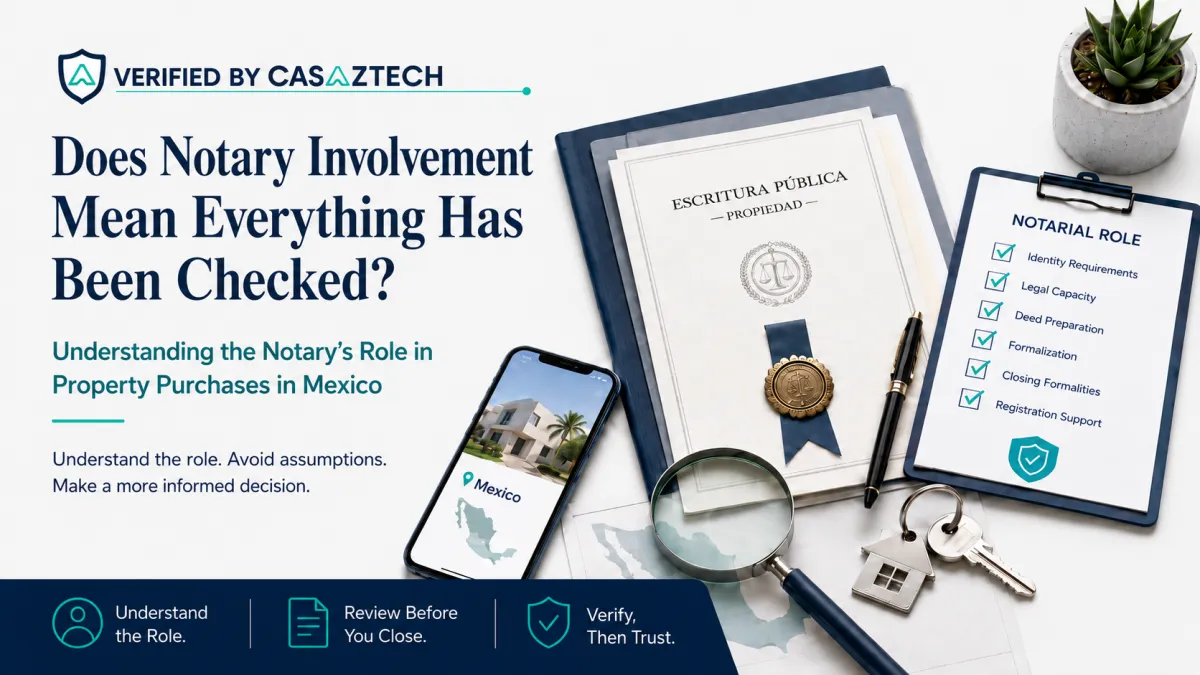
Does Notary Involvement Mean Everything Has Been Checked?
One of the most repeated pieces of advice in property groups is simple:
“Do not worry. The notary will check everything.”
It sounds reassuring because it contains an important truth. The notarial process is an essential part of a property purchase in Mexico. It provides legal certainty, addresses the public deed, and helps ensure that the transfer follows the required legal formalities.
The problem is the word everything.
Buyers may hear it as confirmation that the seller has been fully investigated, every identification document has been proven authentic, every payment instruction has been independently confirmed, and every statement made by an agent, developer, representative, or seller has been checked against outside records.
That is the myth this guide addresses.
Notary involvement is important. It should not automatically be interpreted as proof that the entire transaction has received a broad, independent investigation.
TL;DR
No. Notary involvement does not automatically mean every person, document, payment request, business relationship, and factual claim connected to a property purchase has been independently investigated.
The notarial process provides an essential legal checkpoint. It addresses matters such as the public deed, identity requirements, legal capacity, title documentation, seller authority, closing formalities, and registration.
That is different from conducting a broader review of the seller’s background, company relationships, reputation indicators, payment consistency, outside claims, and transaction risks.
A notary helps formalize the legal transaction. Buyers should not assume that this means every surrounding detail has already been checked.
Planning to buy property in Mexico?
Take a structured pause before signing or wiring funds. Review the parties, authority, documents, payment instructions, and broader transaction context with better information.
Start a Verify Before You Buy Review
Important note: This guide is for general education and practical due diligence only. It is not legal advice and does not replace guidance from a qualified attorney, notary, accountant, licensed professional, or local professional in Mexico. Notarial laws and procedures vary by state and transaction.
Why the “Notary Checks Everything” Myth Is So Persuasive
Buying property involves significant money, unfamiliar documents, and several professionals. Buyers understandably want to believe there is a final checkpoint where the entire transaction is fully examined.
The notary often feels like that checkpoint because the notary prepares or authorizes the public deed and gives legal form and certainty to the act.
That role is substantial. It is also different from investigating every person, business relationship, payment request, commercial promise, and practical concern surrounding the purchase.
The issue is not notary involvement. The issue is treating that involvement as a substitute for understanding what was actually reviewed, by whom, and for what purpose.
What Does Notary Involvement Mean in a Property Purchase?
Notarial responsibilities are established under state law, so exact procedures may vary across Mexico.
In Quintana Roo, for example, the law describes a notary as an independent and impartial legal professional invested with public faith. The notary authenticates and gives legal form to notarial instruments, advises the people appearing before them, and explains the legal consequences of the act.
For a property deed, the notary’s responsibilities can include examining the relevant property title, referencing Public Registry information, reviewing documents needed for administrative and tax formalities, addressing identity and legal capacity, reviewing the authority of a representative, preparing the deed, obtaining consent, authorizing the instrument, and supporting the registration process.
The Colegio Nacional del Notariado Mexicano similarly describes the notary as a legal professional who receives, interprets, and gives legal form to the parties’ intentions in a public instrument. It also notes the notary’s role in taxes, rights, and the registration of acts performed before them.
These are important protections. They should not be minimized.
But they are still defined legal responsibilities. They are not an unlimited promise that every possible risk connected to the transaction has been independently researched.
What Notary Involvement Does Not Automatically Establish
The presence of a notary should not automatically be treated as confirmation that the seller, developer, agent, or representative has received a complete background investigation.
It does not necessarily establish that every identification document was subjected to forensic examination, every business relationship was researched, or every statement made during negotiations was compared with independent outside information.
It also does not automatically confirm the broader reputation or commercial history of the parties, every bank account or payment instruction, or every promise contained in a listing, brochure, email, or WhatsApp conversation.
A notary may identify an inconsistency that affects the deed and may request additional documents or clarification. But buyers should not assume that every issue outside the defined notarial process was investigated simply because the transaction will eventually close before a notary.
Identity Checks Are Important, but They Are Not a Complete Investigation
A notary must address the identity of the people appearing in the legal act. Quintana Roo law, for example, establishes legally accepted methods for confirming identity and requires the notary to state that the appearing parties have been identified and appear to have legal capacity.
Those requirements are meaningful. They help establish who is appearing for the deed.
But buyers should not interpret that process as proof that the person has also received a broad background investigation.
Identity review for the legal act does not automatically establish that the person’s professional history, business relationships, reputation, prior disputes, or complete transaction story have been independently researched.
It also does not mean that every factual claim made by that person has been confirmed through outside records.
This distinction matters because sophisticated impersonation and document fraud can involve identification that appears legitimate during ordinary visual review.
Recent Reporting Shows Why the Distinction Matters
Recent reporting from several states does not suggest that notaries are unnecessary or generally untrustworthy.
It demonstrates something more practical: false documents and identity theft can target formal legal processes, and notarial organizations and lawmakers continue to strengthen the tools used to identify people and reduce impersonation risk.
Guanajuato: Notaries Are Not Document-Forensics Experts
In April 2026, AM reported on concerns involving cloned and falsified identification documents that can appear authentic.
The president of the state notary association explained that notaries do not have the legal or technical authority to act as document-forensics experts. She also acknowledged that not every notary in the state had access to a biometric reader connected to the national electoral authority.
The practical takeaway is not that identity requirements are unimportant.
It is that reviewing an accepted identification document is not the same as providing an unlimited forensic guarantee that the document could not have been falsified.
Quintana Roo: False Documents Can Also Target Notarial Offices
In July 2026, Noticaribe reported comments from a member of the Quintana Roo Council of Notaries addressing allegations involving false documents.
She explained that notaries can also be exposed to false documentation and identity theft, and that biometric measures have been adopted to help reduce impersonation risk.
That does not mean every transaction involving a notary is questionable.
It means the formal process itself can be targeted by sophisticated fraud, which is why identity controls continue to develop.
Michoacán: Lawmakers Proposed Mandatory Biometric Validation
A 2026 legislative proposal in Michoacán sought to require biometric identity validation in notarial acts.
Reporting on the proposal described concerns involving fraud, dispossession, identity theft, and the misuse of false identity in formal transactions.
The proposal reinforces an important reality: notarial safeguards matter, but responsible buyers should not translate “a notary is involved” into “every risk has already been eliminated.”
Four Common Myths About Notary Involvement
Myth: The Notary Has Fully Vetted the Seller
The notary addresses the seller’s identity, legal capacity, title, and authority as required for the deed.
That is not automatically the same as researching the seller’s broader background, professional reputation, public disputes, business history, or relationships with every other party involved.
Myth: A Document Used in a Notarial Process Cannot Be False
A notarial instrument carries legal weight, but the supporting documents presented during a transaction may still be targeted by impersonation, falsification, or misuse.
The continuing expansion of biometric and digital safeguards reflects the fact that document and identity risks cannot be treated as impossible.
Myth: The Notary Independently Confirms Every Payment Request
The notary may review payment-related information needed for the transaction and deed.
That does not necessarily mean every payment recipient, bank account, third-party transfer, or change in payment instructions has been independently confirmed outside the documents supplied by the parties.
A payment request may have a legitimate explanation. That explanation should still be clear before money changes hands.
Myth: If There Were a Problem, the Notary Would Automatically Find It
The notary focuses on the legal act and the responsibilities attached to it.
Unusual pressure, inconsistent stories, reputation concerns, unclear company relationships, changing payment instructions, or promises made outside the written documents may require a broader review.
A problem can matter to the buyer even when it does not fall squarely within the notary’s defined role.
What Are You Assuming Has Already Been Checked?
The right question is not whether a notary should be involved. The appropriate notarial process is an essential part of completing a property purchase in Mexico.
The better question is:
What am I assuming has been checked simply because a notary is involved?
Before closing, buyers should understand who has addressed the following questions:
Has the seller or representative been reviewed beyond the identification presented for the deed?
Has the authority to sell, represent the owner, or receive funds been confirmed as current and consistent?
Has the payment recipient been compared with the people and companies named in the transaction?
Do the names, roles, companies, documents, and payment instructions make sense together?
Have important inconsistencies, public concerns, or unanswered questions been documented before funds are transferred?
The buyer does not need to personally become an investigator.
But the buyer should know whether anyone has been assigned to perform the broader review they are assuming has already happened.
Notarial Review and Independent Due Diligence Serve Different Purposes
The notarial process and independent due diligence are complementary. They are not competing services.
The notary performs the legal and notarial work required to formalize the property transfer. That includes the public deed, identity and capacity requirements, title documentation, legal authority, and closing formalities that apply to the transaction.
Independent due diligence looks across the broader transaction for a different purpose. It can review the people, businesses, public information, payment consistency, outside claims, reputation indicators, unexplained relationships, red flags, and unanswered questions surrounding the purchase.
One helps formalize the transaction correctly.
The other helps the buyer understand whether the available information raises broader reasons to pause, ask for clarification, or obtain additional professional advice before proceeding.
When a Broader Review May Be Useful
A broader review may be particularly useful when the buyer is purchasing from another country, has not met all parties in person, or is being asked to send a reservation payment or deposit before the deed is completed.
It may also be useful when a power of attorney or corporate representative is involved, when different names appear across the contract and payment instructions, or when the account receiving funds does not clearly match the contracting party.
Other reasons to pause include changing payment instructions, pressure to pay quickly, important promises that appear only in messages or marketing materials, and repeated assurances that additional questions are unnecessary because “the notary will handle everything.”
None of those circumstances automatically proves wrongdoing.
They do indicate that the broader transaction deserves a clear, structured review before the buyer becomes financially committed.
When to Use a Verify Before You Buy Review
Verified by Casaztech provides independent, structured due diligence support for property purchases in Mexico.
A Verify Before You Buy review can examine the people, businesses, authority, available records, payment information, transaction relationships, and broader context before money changes hands.
The goal is not to replace the notary or perform the notary’s legal function.
The goal is to help identify inconsistencies, red flags, unclear relationships, unusual payment requests, public information that deserves attention, and questions that remain unanswered before the buyer commits.
Not every inconsistency means the transaction is fraudulent. But unexplained inconsistencies should not be ignored simply because a notary will eventually participate in the closing.
Verified by Casaztech helps buyers take a structured pause, understand the available information, and ask better questions before signing or wiring funds.
Start a Verify Before You Buy Review
Final Thoughts: Use the Notary, but Avoid the Assumption
Notary involvement is a necessary and valuable part of a property purchase in Mexico.
The notary provides legal certainty, addresses the public deed, reviews relevant title documentation, confirms identity and legal capacity through permitted methods, and handles important formalities required for the transfer.
The mistake is assuming that this essential legal role automatically includes a complete independent investigation of every person, business, claim, payment instruction, reputation concern, and practical risk connected to the purchase.
A careful buyer does not bypass the notary.
A careful buyer understands what the notarial process covers, avoids assigning it responsibilities it may not have, and makes sure broader questions are answered before money changes hands.
Understand the role. Avoid assumptions. Make a more informed decision.
Start a Verify Before You Buy Review
Explore all Due Diligence Guides
Frequently Asked Questions
Does a notary in Mexico check everything in a property purchase?
No. The notary performs an essential legal and notarial review, but notary involvement should not automatically be interpreted as a complete independent investigation of every person, claim, payment request, business relationship, and transaction risk.
Does the notary verify the seller’s identity?
The notary must address the identity of the people appearing in the notarial act using methods allowed by applicable law.
That legal identification process is not necessarily the same as forensic document examination, background screening, or a broader investigation of the seller’s history and business relationships.
Does the notary verify that the seller has authority to sell?
The notary reviews the relevant title documentation and the legal authority of a person acting for an owner or company as required for the deed.
Buyers should still avoid assuming that every surrounding relationship, commercial representation, or payment request has received a broader independent review.
Can false documents or identity theft affect a transaction involving a notary?
Yes. Recent reporting and legislative proposals in several states have discussed false identification, impersonation, document fraud, and the expansion of biometric safeguards.
Notary involvement provides important legal protections and reduces risk, but no single process makes sophisticated fraud impossible.
Why use independent due diligence when a notary is already involved?
Independent due diligence looks beyond the formal deed process.
It can review the parties, businesses, available public information, payment consistency, outside representations, reputation indicators, and transaction narrative to identify red flags or unanswered questions before the buyer commits.
Sources and Further Reading
Congress of Quintana Roo: Ley del Notariado para el Estado de Quintana Roo, including the statutory role of the notary, examination of property titles, identity requirements, and legal capacity.
Colegio Nacional del Notariado Mexicano: Guidance on the notary’s role in legal certainty, public instruments, taxes, and registration.
AM Guanajuato: Reporting on identity-document fraud, biometric-reader availability, and the limits of expecting notaries to act as document-forensics experts, April 11, 2026.
Noticaribe: Reporting on false documents, identity theft, biometric measures, and statements from a member of the Quintana Roo Council of Notaries, July 13, 2026.
Quadratín Michoacán: Reporting on a proposal for mandatory biometric identity validation in notarial acts, April 8, 2026.